Guides
Car seats in a limo or black car: what Washington families should know
Do kids need car seats in a limo or black car in Washington? What state law says about for-hire vehicles, and how to plan a safe Sea-Tac ride with children.
Washington's child restraint law, RCW 46.61.687, includes an exemption for for-hire vehicles, so a limousine or black car is not legally required to have a car seat. That exemption does not change the safety picture. Children are still safest in a seat matched to their age and size, so plan for one whenever you can.
Families flying in or out of Sea-Tac often ask about this in the same breath as luggage and pickup times. The short answer above covers the legal question; the rest of this guide covers the practical one: how to make sure your children ride as safely in a hired car as they do in your own.
What Washington law actually requires
Under RCW 46.61.687 the general rules for children in passenger vehicles are, in summary:
- Children under 2 ride rear-facing in a car seat until they reach the seat's height or weight limit.
- Children up to age 4 who have outgrown rear-facing ride in a forward-facing seat with a harness.
- Children who have outgrown a harnessed seat ride in a booster until they are 4 feet 9 inches tall.
- Children under 13 ride in the back seat where it is practical.
These summaries are not legal advice; read the statute itself for the exact wording, and check for any later amendments.
The for-hire exemption, and why it is not the whole story
The same section lists vehicles it does not apply to, and for-hire vehicles are named among them. In plain terms, Washington does not require a chauffeured vehicle to supply or use a child restraint.
That is a legal statement, not a safety recommendation. Crash physics are the same whether the vehicle is a family minivan or a black SUV, and federal safety guidance from NHTSA on car seats and booster seats applies regardless of who owns the car. Families who are careful at home generally want the same standard on the way to the airport.
Telling us about children when you request a quote
The most useful thing you can do is give us the details early. When you request a quote, include:
1. The number of children traveling.
2. Each child's age, and approximate height and weight if they are near a transition between seat types.
3. Whether you will bring your own seats.
4. Any stroller, travel crib or extra gear coming along.
We will confirm what can be arranged for your ride. The fleet page also notes this under fleet questions, and it is the same process for airport runs, weddings and day trips.
Bringing your own car seat
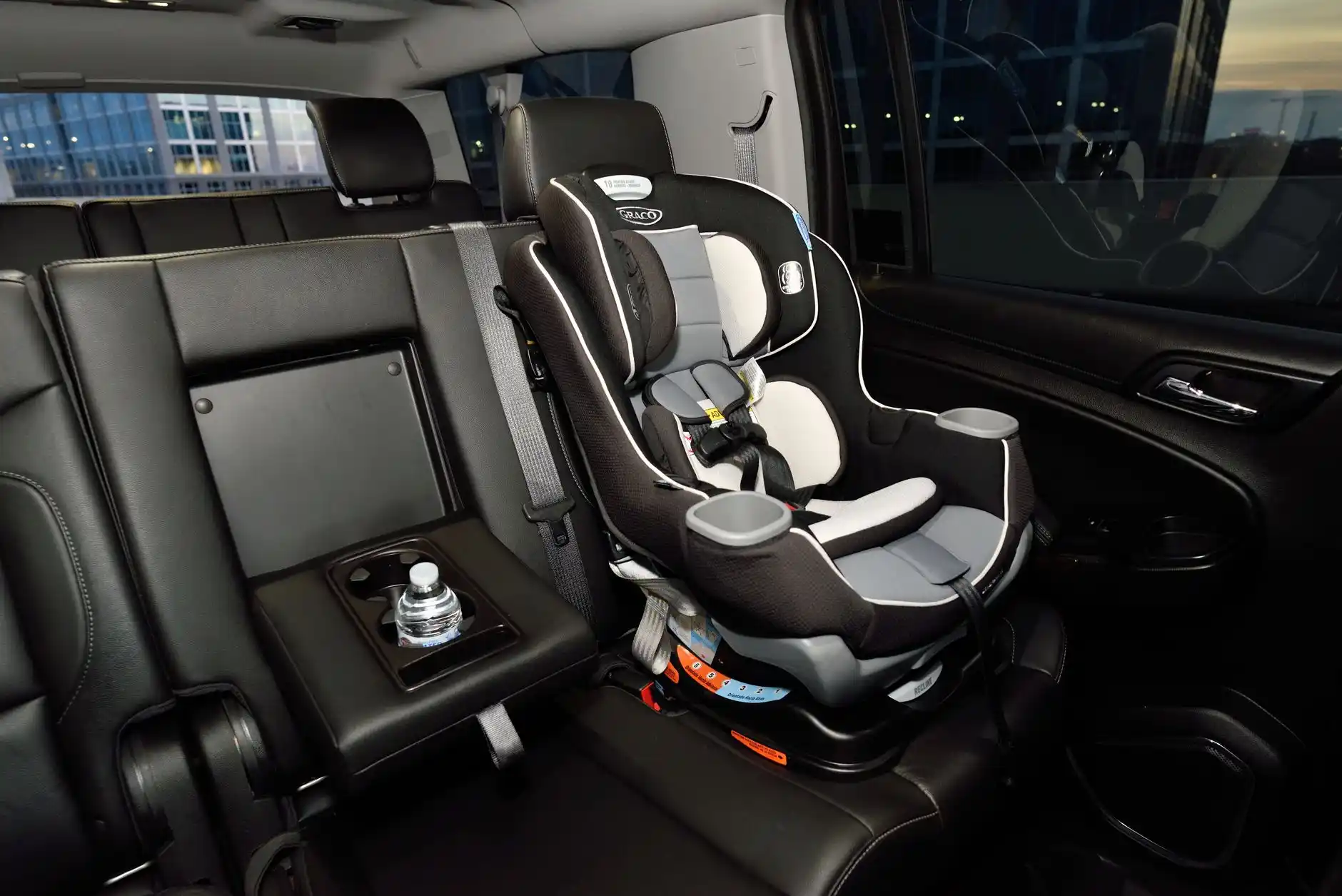
Many families travel with their own seat because it is the one the child knows and the one the parent knows how to install. If you plan to do this:
- Allow a few extra minutes at pickup for installation, and practice the seat-belt installation at home if you usually use LATCH anchors.
- Check that the seat is approved for aircraft use if you intend to use it on the plane too; the label on the seat will say.
- Consider a travel bag for the seat if you plan to check it with the airline.
- Remember that the seat comes with you at the end of the ride, so count it with your luggage.
Choosing the vehicle with car seats in mind
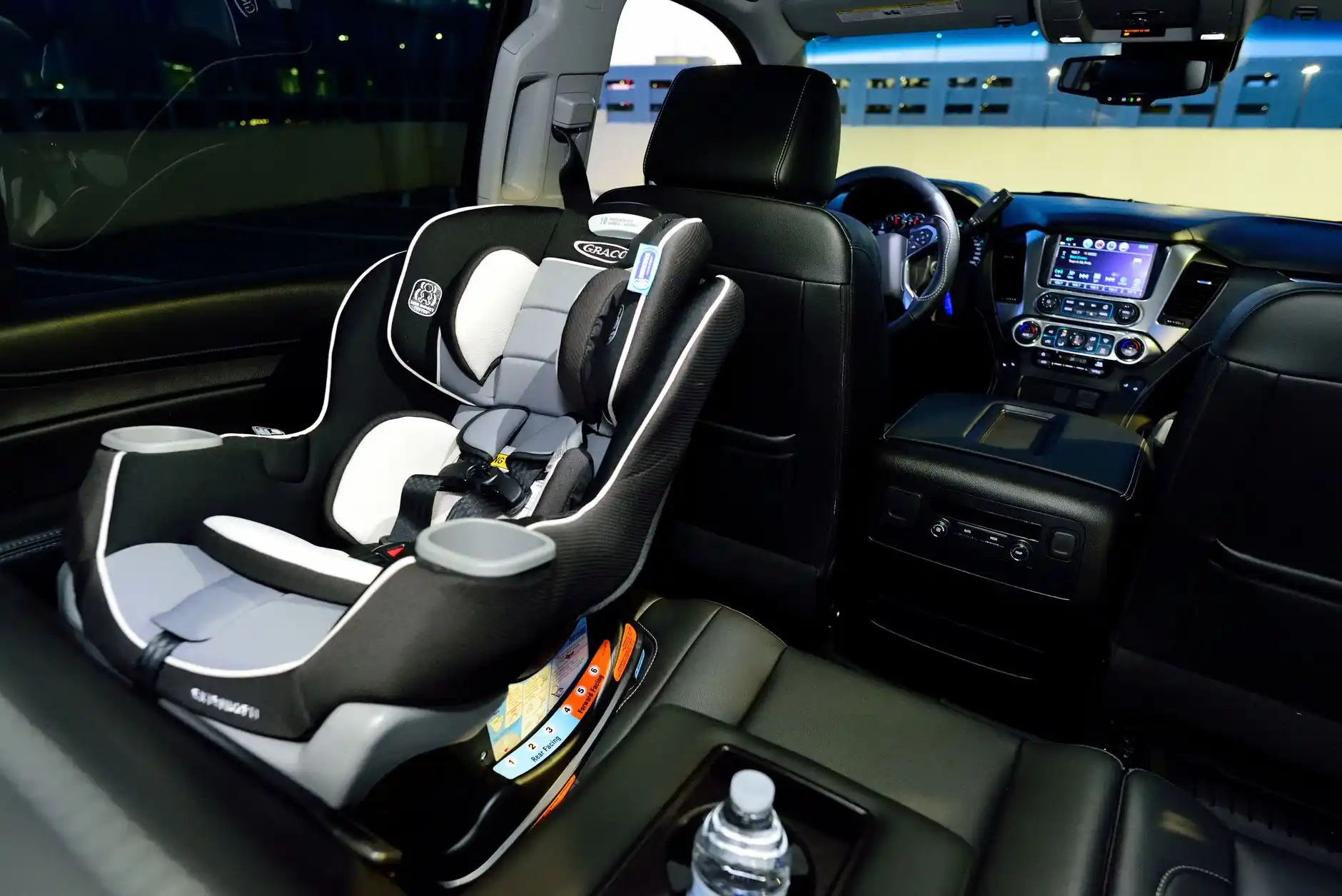
Car seats change the math on seating. A rear-facing seat takes up more room front to back, and two or three seats across one row may not fit in every vehicle.
For a family of four with one or two car seats, the Luxury SUV, a Cadillac Escalade or Chevrolet Suburban, usually gives the best mix of seating and cargo space. Larger families or two households traveling together often find the Executive Sprinter more comfortable, with room for bags and strollers in the back. A sedan can work for one parent and one child with light luggage. Our guide to choosing a sedan, SUV or Sprinter goes into more detail.
Airport arrivals with little ones
Arrivals are where planning pays off most. After a long flight, nobody wants to wrestle a seat into a car at a busy curb. A meet-and-greet inside the terminal gives you a chauffeur to help with bags while you manage the children, and the vehicle is waiting in the designated area rather than circling.
If your flight is delayed, a pickup booked with your flight number follows the arrival; our article on flight delays and airport pickups explains how that works. For early departures with sleepy kids, see our guide to early Sea-Tac departures.
Older kids and the back-seat rule
Washington's law asks that children under 13 ride in the back where practical. In a sedan with two adults and one child, that is easy. In an SUV or Sprinter, it is almost automatic. Teenagers who have outgrown boosters simply use the seat belt like any adult passenger, and the chauffeur will ask everyone to buckle up before departure.
FAQ
Is a limousine company in Washington required to provide a car seat?
The state child restraint law exempts for-hire vehicles, so there is no legal requirement under that section. Tell us your children's ages when you request a quote, and we will confirm what can be arranged.
Can I install my own car seat in the vehicle?
Yes, many families bring their own seat. Let us know ahead of time so the right vehicle is assigned and a few minutes are allowed for installation at pickup.
Which vehicle fits two car seats and luggage best?
For most families, the Luxury SUV is the practical choice. Larger families, or those with strollers and several suitcases, are often more comfortable in the Executive Sprinter.
Does my child need a booster seat in a black car?
Legally, the for-hire exemption applies; for safety, a child who has not reached 4 feet 9 inches is better protected in a booster. Mention the child's age and size when you book so we can plan accordingly.
Can a child ride in the front seat of a limo or SUV?
Washington's law asks that children under 13 ride in the back where practical. In a chauffeured vehicle the front passenger seat is rarely needed, so children ride in the rear.